
Hi! Can you introduce yourself?
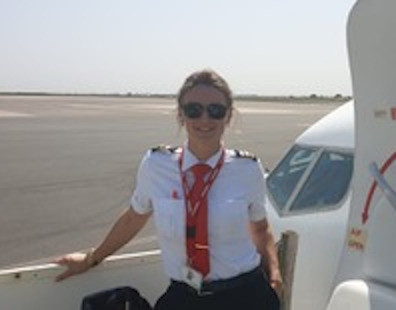
My name is Anne Klein-Haneveld, and I am 25 years old. I started the flight training at AIS Flight Academy in September 2013 and completed it in November 2015. Currently, I am working as First Officer for Corendon Dutch Airlines on the Boeing 737-800NG. We are based in Amsterdam, or Schiphol Airport.
Can you briefly describe a working day as a pilot?
A working day as a pilot can look very different. Flying from your home base or not, there are also days when you get in a taxi with the crew and then go to another base. It is also not a 9 to 5 job, the working day often starts at strange times. As an example, I take a day at Corendon Dutch Airlines. For example a flight to Brazil. It is of course not possible to fly to Brazil in 1 stretch (without stopovers) in a B737-800 from Amsterdam.
Hence, my next story: With Corendon we fly to holiday destinations, Corendon is, therefore, a holiday provider. In the summer-these are often shorter distances, so we mainly do destinations around the Mediterranean (These are distances that we can fly back and forth in 1 day).
In order to find the sun in the wintertime, we quickly have to fly a lot further, for example to Gambia (Africa) or the Canary Islands (Spain).
These distances are longer, so we sometimes cannot manage to fly there and back in 1 day. Then you speak of a Lay-Over;
in other words, we sleep at our destination, and then we can carry out the return journey a day or a few days later.
Last winter we as Airline flew to a new destination for the first time. Namely, Natal in Brazil.
With a Boeing 737-800 this does not work in one go, so we will make a stopover in Tenerife from Amsterdam and then continue our journey to Brazil. During this stopover we refuel, and we do a crew change.
So the crew that flew the first part of Amsterdam – Tenerife will then get off the plane and a new crew that is already in Tenerife will board to continue the flight to Brazil. They then arrive in Brazil, do a turnaround (loading and unloading passengers, refueling, luggage, etc).
And flying the plane back to Tenerife. Once back on Tenerife, this crew disembarks and the “equipped” crew gets back on board to fly the last part of Tenerife – Amsterdam. The crew that will remain behind on Tenerife and are resting will a day later join another airline as a
passenger and be positioned back to Amsterdam. What does our time look like while resting on (in this case) Tenerife?
We have a designated hotel on Tenerife where we are taken and picked up every time with a special Taxi bus.
Depending on the length of time we have, we all go for a bite to eat in a nearby eatery or order something to eat in the hotel.
Sometimes we have a little more time, and then you can relax a little by the pool or discover the island for a few hours.
It is about getting enough rest to be able to fly fit again. So it is not a holiday either.
What do you like most about being a pilot?
Actually, I like everything about this profession. The forces that are released during a Take-off to then lift the plane into the air still have something magical. I enjoy working precisely and with perfectionism. Now we do everything in aviation according to checklists and procedures.
Everything is laid down in prescribed SOPs (rules) that we as a crew must adhere to. I find this very pleasant to work.
It provides structure but also unity. Because even if you are in the cockpit with a colleague who may have had a completely different nationality,
those SOPs again offer a guideline so that everyone knows where he or she stands and no miscommunication can occur. Furthermore, I think it is great
fun to manage during a turnaround whether everything is going well. Because a lot has to be done in a relatively short time.
The passengers disembark together with the accompanying luggage that they have with them in the cabin. The luggage of the new passengers who have checked in is in the cargo hold. Usually, a cleaning crew comes on board and does a quick round of the cabin and toilets.
The fuel supplier is waiting outside for us to report how much fuel we want to take with us to our next destination.
As pilots ourselves, we also do our own checks in the cockpit. In other words, the cockpit is completely prepared and prepared for the next flight.
We do a walk around the plane outside to see what the status of the plane is on the outside.
And as pilots, we give a briefing about how we are going to do the return flight and what to expect.
Then the new passengers will come back on board, and we will soon be ready for departure.
Do you have any tips for the boys and girls who want to become pilots at AIS Flight Academy?
The tips I would like to share are the following:
Choose this profession because it is your passion and not because you want to make money;
if you want to become a pilot you have to be 100% sure that this is what you want.
As far as I am concerned, a motive such as “making money” is not covered.
During the training but also for some time afterwards, you will have to make sacrifices.
There will be very hard work and all your free time will be in it.
Aviation is a very dynamic sector with many possibilities and opportunities.
Motivation, passion and preparation are THE keywords to make your career as a pilot a success.
And then what you have in your hands is a beautiful and radiant career in the air with the most beautiful office you can imagine.
I still learn every day. As a pilot you never stop learning, you want to keep improving yourself, and you continue to strive for the highest possible.
Do you recognize yourself in my words and do you feel that itch and drive inside yourself? I think you know enough!